


A customer searches for a company online, finds a website that looks familiar and decides to make a purchase or share personal information. The logo looks right. The products are recognisable. The website looks professional. At first glance, there is very little to suggest that the business behind it is not the company the customer intended to visit.
But the website is fake.
What makes this problem more concerning today is how easily artificial intelligence can be used to create convincing websites. Producing website content, recreating familiar visual elements, and writing realistic product descriptions no longer requires the same amount of time or technical expertise as it once did. With AI tools becoming more accessible, creating convincing website imitations is getting easier, making it harder for legitimate businesses to protect their online identity.
For Indian businesses, this is not just another cybersecurity concern. A fake website using a familiar brand name can affect customer confidence, lead to lost sales, damage reputation, and weaken the trust a company has spent years building.
This is why brand protection, lookalike website detection and domain takedown are becoming increasingly important. The real concern is not just that someone can create a website using your brand identity. It is that customers may not realise they are dealing with an unauthorised website until something goes wrong.
1. How Artificial Intelligence Is Changing Website Impersonation
Website impersonation is nothing new. What has changed is how quickly and easily convincing copies can now be created.
Generative AI tools can produce professional website content, realistic product descriptions, customer service messages and other elements commonly found on business websites. AI-assisted website builders have also made it easier to put together complete web pages without needing extensive design or coding experience.
A February 2026 investigation documented how an AI website-building tool was misused to create a lookalike website impersonating a recognised cybersecurity business. The incident showed how tools designed to simplify website creation can also be used to reproduce the appearance of established brands.
The bigger concern is how these tools can reduce the effort involved in creating website content and reproducing an existing digital identity. This makes it possible for convincing imitations to be created with considerably less manual work.
However, it is important to understand that not every fraudulent website is AI-generated, and the use of AI alone does not make a website malicious. The concern is how these tools can be combined with existing website impersonation techniques.
For legitimate businesses, this means that a professionally designed website is no longer enough to establish credibility. A fraudulent alternative can look just as polished while having no authorised connection to the company.
Brand protection must now account for the possibility that a convincing online identity can be reproduced without the brand owner’s permission.
2. Why This Threat Matters in the Indian Market
India’s growing digital economy has opened up significant opportunities for businesses to reach customers online. People regularly use websites to discover products, compare services, make payments, contact companies and verify business information.
But the same digital reach also creates opportunities for fraudulent websites to take advantage of the trust established brands have built with their customers.
In 2026, Indian government action and media reporting brought attention to fraudulent websites and databases hosted on legitimate digital infrastructure, including websites impersonating financial institutions. These incidents show how fraudulent destinations can operate separately from the genuine organisations they claim to represent.
These incidents should not automatically be classified as AI-generated attacks. However, they highlight the wider environment in which AI-assisted website impersonation can take place.
For Indian enterprises, the business risk is quite straightforward. The more customers recognise a brand and rely on its online channels, the greater the potential damage when an unauthorised website uses that familiarity to appear legitimate.
A fake website may target customers, business partners or prospective buyers. It could use a company’s identity to display misleading information, collect enquiries or encourage customers to complete transactions through an unauthorised channel.
The impact often goes beyond the fake website itself. Customers may start questioning whether the brand can be trusted, while the genuine business is left handling complaints and trying to restore customer confidence.
This makes website brand protection a business reputation issue as much as a digital risk concern.
3. When a Website Looks Genuine, What Can Customers Trust?
One of the biggest challenges with AI-assisted website impersonation is that many of the usual signs of a credible website can now be reproduced.
A professional layout, well-written content, consistent imagery, and detailed product pages can make almost any website look legitimate. But these elements only tell us how a website has been presented. They do not confirm whether the business behind it is authorised to represent a particular brand.
This matters because most customers make decisions quickly when browsing online. They might recognise a logo, see familiar products, and naturally assume they are visiting the company’s official website.
Even an encrypted connection is not proof that a website is genuine. HTTPS helps protect information exchanged between a user and a website, but it does not confirm that the website belongs to or is authorised by the brand it displays.
The same applies to professional-looking contact pages, customer support details and privacy policies. Simply having these elements does not establish a website’s relationship with the business.
For companies, the bigger concern is that brand recognition can be misused even when the genuine website has not been compromised.
Customers see the familiar brand identity, but the business has no control over the website displaying it. In many cases, the difference between an official and an unauthorised website only becomes clear after something goes wrong.
This is why fake website detection cannot rely on appearance alone. What really matters is verifying whether the website is authentic and whether it has a legitimate connection with the brand.
4. The Hidden Cost of an Unauthorised Digital Identity
A fake website can start affecting a business long before the company even knows it exists.
Imagine a customer who believes they have placed an order through an official website. The order never arrives, so they contact the genuine company, post a complaint online or warn others against purchasing from the brand.
From the customer’s point of view, the company has failed to deliver. They may not even realise that the transaction took place through an unauthorised website.
This can create several problems for the business.
Customer trust can deteriorate. Customers may hesitate before purchasing from the genuine business or recommending it to others.
Revenue opportunities can be lost. Someone who interacts with an impersonating website may never reach the authorised business. Other customers may simply abandon their purchase after coming across conflicting information.
Reputation management becomes more difficult. The company may have to respond to complaints about transactions, services or offers that it never provided in the first place.
Customer support teams face additional pressure. Employees may spend time responding to enquiries, explaining that the fake website is not affiliated with the company and guiding affected customers towards appropriate assistance.
The brand’s credibility can come into question. Even when the business has nothing to do with the fake website, customers may associate the negative experience with its name.
The actual impact depends on how the website is being used. Some fake websites are created to mislead customers into making payments, while others may attempt to collect personal information or present themselves as official service channels.
In each case, the underlying problem is the unauthorised use of an established brand identity.
For businesses that have invested years in customer experience, marketing and reputation building, this means dealing with problems caused by an online presence they neither created nor control.
5. Why Fake Domains Create a Separate Brand Protection Challenge
A company can have a completely secure official website and still face brand impersonation elsewhere online.
The reason is simple. A fraudulent website can operate through a separately registered domain rather than using the company’s own website infrastructure. The genuine website may continue working perfectly while another domain uses a similar name or brand identity to mislead visitors.
This is an important distinction for business leaders to understand. Securing your official website does not stop someone from registering another domain that resembles your company’s name.
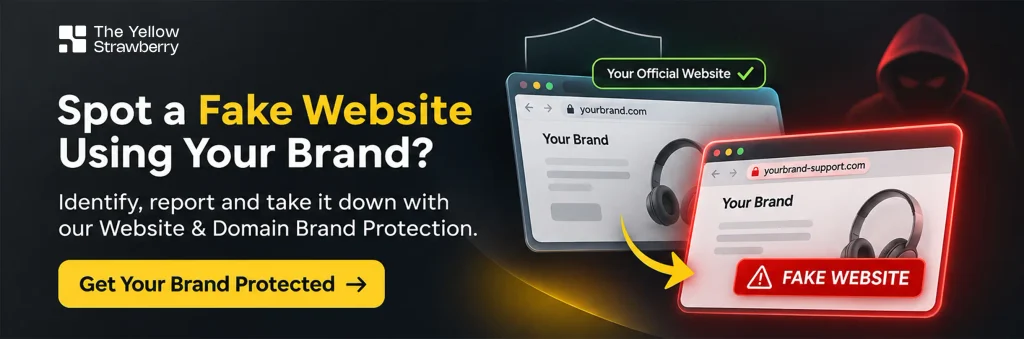
For example, imagine a fictional business called Nova Circuit. The company operates through its official domain, but an unrelated party registers another domain using the same brand name along with words such as “support” or “service”.
To someone unfamiliar with the company’s official web address, the additional domain may look perfectly plausible. If the website also uses familiar branding, customers may naturally assume that the two are connected.
Businesses looking to address these risks can explore professional website and domain brand protection services to identify suspicious domains and protect their online identity.
It also explains why fake domain detection is such an important part of website brand protection. The risk does not stop at suspicious activity on the genuine website. Unauthorised domains can create entirely separate channels through which a company’s identity and reputation are misused.
For businesses operating across India, this becomes particularly relevant when customers interact with regional services, local business units or multiple official web destinations.
The issue is not simply who owns a particular domain name. What matters is whether an unauthorised website is using that domain to create confusion about the identity of a business.
6. Why Taking Down a Fake Website Matters
Finding an unauthorised website is an important first step, but identifying it does not automatically remove the risk to customers.
As long as a fake website remains accessible, people may continue visiting it and assuming that they are dealing with the genuine business. The brand may also continue to be associated with activity that it has no control over.
This is where domain takedown becomes important.
Domain takedown refers to the process of taking action to disable or remove a domain associated with fraudulent or unauthorised activity. Depending on the situation, this may involve action against the domain itself or the website infrastructure supporting it. The available options and outcomes depend on the evidence, applicable requirements and decisions made by the relevant providers or authorities.
It is worth noting that a takedown cannot be guaranteed in every case. Removing one website also does not mean that another unauthorised domain will never appear.
However, taking action against an active fraudulent website can help limit continued exposure and reduce the chances of customers being misled through that particular destination.
This distinction matters when businesses evaluate brand protection services. Simply receiving a report about a fake website is not the same as getting support to address its continued availability.
Businesses facing website impersonation can explore fake website takedown services to understand how suspicious websites can be investigated and appropriate enforcement action pursued.
7. Why the Threat Can Continue After a Website Is Removed
Getting a fraudulent website taken down does not necessarily mean the wider problem of brand impersonation has been resolved.
The website may be disabled, but another domain using the same brand identity could still be active. A similar website might also appear later, creating another opportunity for customers to be misled.
This is particularly relevant for established brands with a strong online presence. Their names and identities are already familiar to customers, making them attractive to people looking to exploit that familiarity.
For this reason, businesses should not measure the risk only by the number of fake websites they discover at a particular point in time. They also need to consider the possibility of recurring impersonation and the continued misuse of their brand name across different domains.
For customers, repeatedly coming across fake websites can make it increasingly difficult to identify official channels. For the genuine business, recurring incidents can mean more reputational concerns, customer complaints, and additional pressure on internal teams.
This does not mean that every removed website will return or that every business will face repeated attacks. It simply means that removing one fraudulent website should not automatically be treated as proof that all related risks have disappeared.
Effective brand protection needs to address the immediate threat while recognising the possibility of further domain impersonation.
8. Which Businesses Should Pay Attention?
AI-assisted fake websites can affect businesses across different industries. The level of exposure generally depends on how recognisable a brand is, how customers interact with it and how much they rely on its official online channels.
Companies operating in ecommerce, financial services, technology, travel and other customer-facing sectors may have particular reasons to pay attention. Customers in these industries regularly visit websites to compare options, make decisions and complete transactions.
However, these are not the only businesses at risk. Website impersonation can affect any organisation whose name carries customer trust and whose identity could be misused to influence online behaviour.
For Indian enterprises, the more important question is whether a fake website using their brand identity could mislead customers, damage their reputation or create confusion about their official services.
A company does not have to sell products online to face this problem. Even businesses that primarily use their websites for enquiries, service requests or business relationships can experience reputational damage when their identity is misused.
Ultimately, it comes down to the relationship between a brand and the people who trust it.
9. Brand Protection in an AI-Driven Digital Environment
Artificial intelligence is changing the way websites and digital content are created. It is also making it easier to reproduce different elements of an established brand’s online identity.
For businesses, the challenge is not to assume that every unfamiliar website is fraudulent. It is to understand that a professional appearance does not prove authenticity, and that an unauthorised website can operate completely independently of the genuine company’s systems.
Traditional website security remains essential, but it addresses a different problem from a fake domain using a company’s name elsewhere online.
This is why brand protection should also include monitoring for lookalike websites, identifying unauthorised domains and taking appropriate domain takedown action.
For Indian businesses, this is becoming increasingly relevant as customers continue to rely on online channels to discover, evaluate and interact with organisations.
A company’s reputation is not limited to what customers see on its homepage. It is also shaped by their experience with the brand across the wider digital environment.
When an unauthorised website uses that identity, the genuine business may end up managing the consequences despite having no involvement in creating or operating it.
The purpose of brand protection is to address this gap between the identity a business has worked hard to build and the unauthorised websites that may attempt to exploit it.
Protect Your Brand with The Yellow Strawberry
The Yellow Strawberry provides Website and Domain Brand Protection for businesses concerned about fake websites, lookalike domains and the unauthorised use of their online identity.
Our service focuses on identifying and addressing website and domain impersonation, including fake website identification and domain takedown support.
As AI-assisted website creation becomes more accessible, protecting a brand means looking beyond the security of its official website. Businesses also need to recognise the risks created by unauthorised websites that may appear elsewhere online.
If your business is concerned about fake domains, lookalike websites, or the misuse of its brand identity, The Yellow Strawberry can help you understand the available brand protection options and explore the right support for your requirements.
Do not let an unauthorised website damage the trust you have spent years building.
Get Your Brand Protected.